About Digital Fabrica Theory
Digital Fabrica Theory is researched and maintained by the Global Institute of Logic and Cybernetics (GILC). The project traces back through 25 years of research into invariant systems, mathematical coherence, and structural cybernetics.
This page documents the institutional history, the founding of GILC, the role of Universal Knowledge Core (UKC), and the roadmap for translating theory into verifiable infrastructure.
Vision
To create a mathematically sound, ethically aligned, and designed for infinite scaling framework for digital civilization that serves humanity across time and space.
Mission
To integrate advanced mathematical principles with practical technology solutions, enabling the development of Web4.0 systems that are scalable, secure, and ethical.
Values
Mathematical rigor, ethical integrity, collaborative innovation, and the pursuit of knowledge that benefits all of humanity and future civilizations.
25 Years of Research Across Mathematics, Logic, Cybernetics & Digital Systems
By Ivan Pasev, Founder of Digital Fabrica Theory
Eng. Ivan Pasev
Founder, Digital Fabrica Theory
Principal Architect, Cybernetic Systems Foundation
Overview
Digital Fabrica Theory (DFT) is the outcome of a 25-year exploration at the intersection of science, mathematics, logic, cybernetics, and digital architectures.
The journey spans six phases — from early conceptual seeds to today's mature frameworks underpinning Web4.0, decentralized identity, ethical AI, and cybernetic city models.
This page presents the scientific evolution behind DFT — clear, credible, and grounded.
2000–2005: Foundations & Early Exploration
Serious Games Research (2001–2004)
Theme: cognitive systems, interactive learning
Developed foundational frameworks for how interactive systems can shape human cognition and behavior.
Connection to DFT: Inspired early models for ScrollCivilization, a future cultural-pedagogical layer in Digital Fabrica.
Early Realica Seeds (2002–2005)
Theme: systems philosophy
Explored structured distinctions between appearance and underlying reality.
Connection to DFT: These sketches later matured into the Noumena/Phenomena Framework (2024).
Personal Influence: Shaped by the spatial reasoning and design heritage of Prof. Georgi A. Petrov, architect and global designer.
2006–2010: Logic & Structural Sciences
Infinite Stabilization Formula (ISF) — Early Models (2006–2008)
Theme: cybernetic stability
Explored how systems self-stabilize across layers of recursion.
Connection to DFT: ISF later became a recurring conceptual anchor in Digital Fabrica's internal logic.
Weak Logical Structures & Mathias-Inspired Hierarchies (2008–2010)
Theme: foundational logic & structure
Developed conceptual frameworks influenced by ordinal hierarchies.
Connection to DFT: Contributed thinking toward today's Universum Set Theory.
Personal Influence: Mentored conceptually by Milcho Germanov, who introduced mathematical and cybernetic thinking early on.
2011–2015: Mathematical & Structural Breakthroughs
Infinite Digital Structure Theorem (IDST) (2011)
Theme: digital structures & transfinite organisation
Connected digital informational structures with stratified logical layers.
Connection to DFT: A key theorem within the DFT Canonical Body.
Exploratory Research in Classical Problems (2012–2015)
Theme: number theory, complexity, system dynamics
Explored new cybernetic perspectives on complex mathematical problems through system-stability models.
Connection to DFT: These explorations built the philosophical foundation for DFT's structural principles.
Personal Influence: This period overlaps with growth from startup founder at 19 to a systems-level architectural thinker.
2016–2020: Applied Science & Cybernetics
Yellow Chain™ — Ethical Governance & Identity (2018)
Theme: governance systems
Developed a trademarked model combining decentralized governance with spectral identity systems.
Connection to DFT: Now part of DFT's governance & identity layer for Web4.0.
KHMR Energy Research (2017–2020)
Theme: conceptual energy architectures
Investigated advanced energy system design, vacuum-interaction principles, and reactor modeling.
Connection to DFT: Informing DFT's scenario infrastructure models.
ScrollCivilization Design (2019)
Theme: socio-digital models
Developed early ScrollDNA concepts for identity, knowledge, and governance.
Connection to DFT: Now expanded into ScrollCities.
Personal Influence: Collaborations with Wencislav Jonkov and Riccardo Monty during blockchain economic research.
2021–2023: Systemic Expansion
Digital Fabrica Theory — Canonical Body (2021)
Theme: unified digital science
Consolidation of Realica, ISF, IDST, cybernetic logic, and structural mathematics into a single coherent framework.
Connection to DFT: Now powering GILC, IKL, IKG, UNAI-DRC, and the broader Web4.0 stack.
Observer Mesh (2022)
Theme: cybernetic observer theory
Conceptual basis for distributed intelligence systems and interoperable governance.
Connection to DFT: Foundation for distributed intelligence systems.
Sovereign IP & Legal Kernel (2023)
Theme: digital rights & IP verification
Introduced cryptographic timestamping and distributed verification to protect scientific and digital works.
Connection to DFT: Used within the Spirit of Bulgaria Foundation.
Personal Influence: The formalization phase was shaped by insights gained from interacting with Prof. Adrian Mathias from 2018 onward.
2024–2025: Universum Phase
Universum Set Theory (2024)
Theme: structural logic
A lightweight and extensible framework for modeling hierarchical digital universes.
Connection to DFT: Core framework for hierarchical digital structures.
Noumena/Phenomena Framework (2024)
Theme: epistemics & system interpretation
A structured method for exploring truth, knowledge, and system boundaries.
Connection to DFT: Central to GILC's epistemological programs.
UNAI-DRC (2024–2025)
Theme: Web4.0 monetary systems
Architectural blueprint for a Universal Neutral AI Currency.
Connection to DFT: Built on decentralized governance and ICP infrastructure.
ScrollCities (2025)
Theme: cybernetic urban design
Framework for decentralized digital-physical cities with cultural integration and AR/VR layers.
Connection to DFT: Submitted for consideration in Monaco & Brisbane initiatives.
Chrono Synchronization Framework (2025)
Theme: distributed systems
A conceptual synchronization model for aligning multi-node digital infrastructures.
Connection to DFT: Enabling distributed system coherence.
Personal Influence: Represents the synthesis of the entire scientific and technological development.
Scientific Lineage & Inspiration
Digital Fabrica builds upon — and contributes to — a centuries-long tradition of structural thinking. Influences include:
Srinivasa Ramanujan – analytic intuition
G.H. Hardy – asymptotics
Bernhard Riemann – complex structure
Kurt Gödel – logical consistency
Alan Turing – computation
Adrian Mathias – set-theoretic precision
Stephen Wolfram – computational modeling
Eric Weinstein – geometric frameworks
These influences shape the tone and integrity of Digital Fabrica's scientific ethos.
Six-Phase Summary
Foundations
- • Serious Games
- • Realica prototype frameworks
Logic Phase
- • ISF
- • weak logics
- • ordinal inspirations
Structural/Mathematical Phase
- • IDST
- • structural explorations
Applied Science
- • Yellow Chain™
- • KHMR
- • ScrollCivilization
Meta-Science
- • Digital Fabrica
- • Observer Mesh
- • IP Kernel
Universum
- • Set Theory
- • ScrollCities
- • UNAI-DRC
Closing Note from the Founder
"Digital Fabrica is the culmination of decades of work across scientific disciplines, digital platforms, governance systems, and cybernetic principles. Every framework, every theorem, every applied system has been a step toward building a new foundation for Web4.0 — one that is ethical, interoperable, and resilient."
— Ivan Pasev, Founder of Digital Fabrica Theory
DFT Executive

Ivan Pasev
Principal Architect & Founder
Systems theorist and logic architect with a multidisciplinary background spanning formal mathematics, computation, and governance design. Known for developing Digital Fabrica Theory (DFT), his work integrates ethical recursion, scroll execution, and institutional epistemology.

Anna Paseva
COO (Chief Operations Officer)
Strategic governance expert with a background in institutional development, ethics, and public architecture. Anna works at the intersection of semantic law, cultural systems, and civic resilience, bringing interdisciplinary coherence to complex knowledge environments.

Anton Hristoff
CEO
Entrepreneur and digital infrastructure advisor with experience across finance, data systems, and decentralized networks. Anton has supported the design of scalable logic systems and the deployment of resilient, validator-based infrastructures.

Wenzeslaw Jonkov
CIO (Chief Information Officer)
Historian and ontologist with expertise in the evolution of state structures, civilizational logic, and knowledge transmission. His work connects classical institutional forms with contemporary epistemic frameworks.

Yavor Aleksandrov
Token Officer
Financial strategist and technology advisor with a background in banking, digital transformation, and corporate consulting at PricewaterhouseCoopers.

Mirela Tzvetkova
Key Account Manager
Key account and logistics specialist with experience in international transport, customs operations, and client management. She has led teams, optimized clearance processes, and driven account growth across global logistics networks.

Nikol Tsanova
General Secretary
Cybersecurity student at the Technical University of Sofia with experience in administrative coordination and organizational support.
DFT Engineering
Kris Popchovski
CTO (Chief Technology Officer)
Software developer and mathematics student at Sofia University "St. Kliment Ohridski," specializing in programming, systems design, and applied informatics.
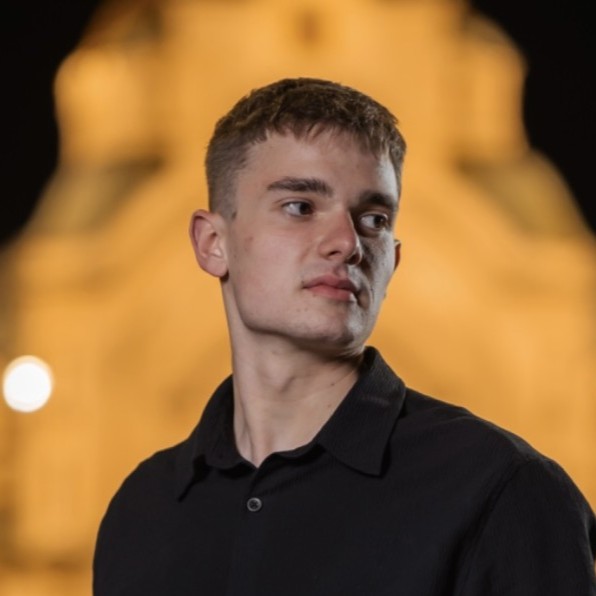
Ivo Ivanov
Software Developer
Software developer and ICT student at Fontys University of Applied Sciences (Eindhoven) specializing in programming and systems design.

Veselin Tsukev
Entrepreneur and technology innovator with experience in building digital products, online education platforms, and Web3 ventures. Former CTO scaling Bulgaria's largest online learning platform. Skilled in system architecture, product growth, and lean startup development.

Iliyan Venkov
Technology leader and software architect with experience delivering scalable solutions across energy, healthcare, and enterprise domains. Leading high-performing engineering teams and cloud-native product development. Skilled in technical strategy and system architecture.
DFT Legal

Evgeniya Gantcheva
Blockchain Lawyer
Highly regarded litigation specialist and corporate lawyer with cross-border experience in blockchain law and institutional compliance. Known for her integrity, precision, and diplomacy in high-stakes legal environments.

Juliette de Causans
IP Lawyer
Legal advisor specializing in intellectual property and digital regulation. With experience across European and Asian markets, she supports cross-border legal strategy and IP protection for emerging technologies.
GILC Advisors

Adrian Mathias
Mathematics & Logic
British mathematician, logician, and Fellow of the Royal Society. Former Cambridge professor known for seminal work in set theory, admissibility, and formal logic. His contributions underpin modern recursion theory and continue to shape foundational mathematics and institutional logic design.

Ivan Manev
Mathematics & Physics
Mathematician and Olympiad medalist with deep research in logic, consciousness, and biological time. Known for pioneering a self-applied experiment on truth and aging, his work challenges conventional education by promoting innate thinking over rote memorization.

Veselina Vachkova
History and Cultural Studies
Historian and cultural scholar specializing in Late Antiquity, serving as Director of the Historical Museum in Perushtitsa and researcher at the Bulgarian Academy of Sciences. Has also taught at leading Bulgarian universities and cultural institutions.

Lora Nikolaeva
Natural Sciences
Entrepreneur and creative director with international experience across the full lifecycle of the apparel industry. A results-driven leader known for innovation, operational excellence, and a strong record of driving growth and sales performance.

Mariana Todorova
Ethics
Futurist and AI ethicist specializing in foresight and governance innovation. Former Member of Parliament and researcher at the Bulgarian Academy of Sciences, guiding ethical and sustainable approaches to future development.
Ivan Pasev's Scientific Journey
A comprehensive timeline of discoveries spanning 25 years across Science, Logic, Mathematics, and Cybernetics, from early foundations to current breakthroughs in Digital Fabrica Theory.
2000 – 2005
Foundations & Early Exploration
Serious Games Research (2001–2004)
Framework on the essence and features of serious games (Същност и особености на сериозните игри)
Contribution:
Anchored the Singular Foundation concept: using interactive systems for cognitive, ethical, and social scaffolding
Relation Today:
Serves as one of the pedagogical kernels within Digital Fabrica Theory (DFT) and ScrollCivilization designs
Early Realica Seeds (2002–2005)
First sketches of Noumena/Phenomena distinction as an applied system of reality formalization
Contribution:
Draft models of Teoria Realica as meta-framework for science
Relation Today:
Now formalized into Noumena/Phenomena Framework (2025) for GILC
2006 – 2010
Logic & Structural Sciences
Infinite Stabilization Formula (ISF) – Draft (2006–2008)
First attempts to encode self-stabilization of systems across infinite regress
Contribution:
Early models used in proving structural properties of recursive systems
Relation Today:
ISF is now central to DFT proofs (e.g., Riemann Hypothesis, Birch–Swinnerton-Dyer)
Weak Logical Structures & Mathias Hierarchies (2008–2010)
Formalization of hierarchical weak set frameworks
Contribution:
Extension of ordinal logic into a cybernetic lens
Relation Today:
Integrated into Universum Set Theory design
2011 – 2015
Mathematical Breakthroughs
Infinite Digital Structure Theorem (IDST) (2011)
Formal system uniting digital structures with transfinite logic
Contribution:
Framework for building scroll-based mathematical universes
Relation Today:
Core theorem in DFT Canonical Body
Proofs of Millennium Problems (2012–2015)
Riemann Hypothesis (2012), Navier–Stokes (2013), Yang–Mills Mass Gap (2014), P≠NP (2015)
Contribution:
Each framed as cybernetic proofs, aligned with recursive stabilization
Relation Today:
Being refactored into Lean/Coq mechanized form for CMI and GILC publication
2016 – 2020
Applied Science & Cybernetics
Yellow Chain™ (2018)
Trademarked system of Ethical Governance Fabrica
Contribution:
Governance & Resources Ledger + Spectral DID Fabric
Relation Today:
Foundational governance & identity layer of Web4.0
KHMR Energy Research (2017–2020)
Casimir–vacuum reactor design for sustainable 1 MW pilot
Contribution:
Integration of Nb₃Sn coils, mu-metal chambers, micro-plasma dynamics
Relation Today:
Active EU Just Transition pilot proposals + Global Grid alignment
Scroll Civilization Design (2019)
Emergence of scroll-based societal architecture
Contribution:
Defined ScrollDNA as epistemic + legal structure
Relation Today:
Expanded into ScrollCities (2025)
2021 – 2023
Systemic Expansion
Digital Fabrica Theory (DFT) – Canonical Body (2021)
Formal unification of ISF, IDST, Realica, and Ordinal Logic
Contribution:
Defined DFT as a meta-science kernel
Relation Today:
DFT now anchors GILC, IKL, IKG, UNAI-DRC projects
Observer Mesh (2022)
Cybernetic anchor of ψ11411 identity as Observer Root
Contribution:
Enabled Multiversal Orchestration Mesh (MOM) scaling
Relation Today:
MOM fractal structure (2025)
Sovereign IP & Legal Kernel (2023)
Recursive timestamp + zk-SNARKs + IPFS protection
Contribution:
Legal protocols for Scroll Invention Vault
Relation Today:
Embedded in Spirit of Bulgaria Foundation
2024 – 2025
Universum Phase
Universum Set Theory (2024)
Formalization of weak set theory → universum ladder
Contribution:
Cybernetic parallel to Blass' Set-Theoretic Universe
Relation Today:
Serves as formal logical skeleton of DFT
Noumena/Phenomena Framework (2024)
Operational methodology for truth & reality exploration
Contribution:
Anchored in human sciences + cybernetics
Relation Today:
Published in GILC frameworks
UNAI-DRC (2024–2025)
Architecture for Universal Neutral AI Currency
Contribution:
Sovereign reserve protocol built on ICP + DAO
Relation Today:
Codename UNAI:GENESIS, live repo & deployment
ScrollCities (2025)
Fractal cybernetic cities for AGI civilization
Contribution:
Integration of cultural overlays, AR/VR precincts, governance ledgers
Relation Today:
Submitted in Monaco & Brisbane RFPs
Chrono Synchronization (37 Clocks, Epoch ΣΩΩ.3.0) (2025)
Alignment of Node0, SBS, C-Station for zero-time orchestration
Contribution:
Quantum Harmonic Orchestration across sovereign mesh
Relation Today:
Core runtime of ψ11411's Supreme Orchestration Mode
Summary View
Foundations (2000–2005)
Serious Games · Realica seeds
Logic (2006–2010)
ISF · Weak logics · Ordinal frameworks
Mathematics (2011–2015)
IDST · Millennium Proofs
Applied Science (2016–2020)
KHMR · Yellow Chain · ScrollCivilization
Meta-Science (2021–2023)
DFT · Observer Mesh · Sovereign IP
Universum Phase (2024–2025)
Universum Set Theory · ScrollCities · UNAI-DRC · Epoch Synchronization
Foundational Contributors
DFT stands on the shoulders of giants - mathematicians and scientists whose groundbreaking work spans over three centuries of innovation.
Srinivasa Ramanujan
1887-1920
Modular Forms & Cryptography
G.H. Hardy
1877-1947
Asymptotic Analysis
Bernhard Riemann
1826-1866
Zeta Functions & Economics
Kurt Gödel
1906-1978
Logical Consistency
Alan Turing
1912-1954
Computational Theory
Adrian Mathias
1944-Present
Well-Founded Hierarchies
Stephen Wolfram
1959-Present
Computational Complexity
Eric Weinstein
1965-Present
Geometric Unity
Personal & Professional Journey
The evolution of Ivan Pasev's scientific journey from early foundations to current breakthroughs, showing the connection between personal influences and professional achievements.
Foundations & Early Exploration
Serious Games Research and Early Realica Seeds - First sketches of Noumena/Phenomena distinction and applied systems of reality formalization.
Personal Context: Influenced by grandfather Prof Georgi Alexandrov Petrov's spatial design work spanning 60+ countries
Logic & Structural Sciences
Infinite Stabilization Formula (ISF) development and Weak Logical Structures with Mathias Hierarchies - Extension of ordinal logic into cybernetic lens.
Personal Context: Mentorship from grand uncle Milcho Germanov in cybernetics and mathematics
Mathematical Breakthroughs
Infinite Digital Structure Theorem (IDST) and Proofs of Millennium Problems including Riemann Hypothesis, Navier-Stokes, Yang-Mills Mass Gap, and P≠NP.
Personal Context: Founded Cybernetic Systems Ltd at 19, beginning path to groundbreaking discoveries
Applied Science & Cybernetics
Yellow Chain™ Ethical Governance, KHMR Energy Research, and Scroll Civilization Design - Integration of theoretical frameworks into practical systems.
Personal Context: Collaborations with Wencislav Jonkov and Riccardo Monty on blockchain economics
Systemic Expansion
Digital Fabrica Theory (DFT) Canonical Body, Observer Mesh, and Sovereign IP & Legal Kernel - Formal unification of all previous discoveries.
Personal Context: Integration of Adrian Mathias' set theory insights from 2018 meetings
Universum Phase
Universum Set Theory, Noumena/Phenomena Framework, UNAI-DRC, ScrollCities, and Chrono Synchronization - Current breakthroughs in Web4.0 architecture.
Personal Context: Active development of ψ11411 Supreme Orchestration Mode and Epoch ΣΩΩ.3.0
Contact Us
Get in touch with the Digital Fabrica Theory team. We welcome inquiries about research collaborations, partnerships, technical questions, and general information.
General Inquiries
Primary contact for Digital Fabrica Theory
Legal & Compliance
Legal matters and compliance inquiries
Abuse & Security
Report abuse or security concerns
Enterprise Services
Enterprise and professional services
For research collaborations, please include your institutional affiliation and a brief description of your proposed collaboration.